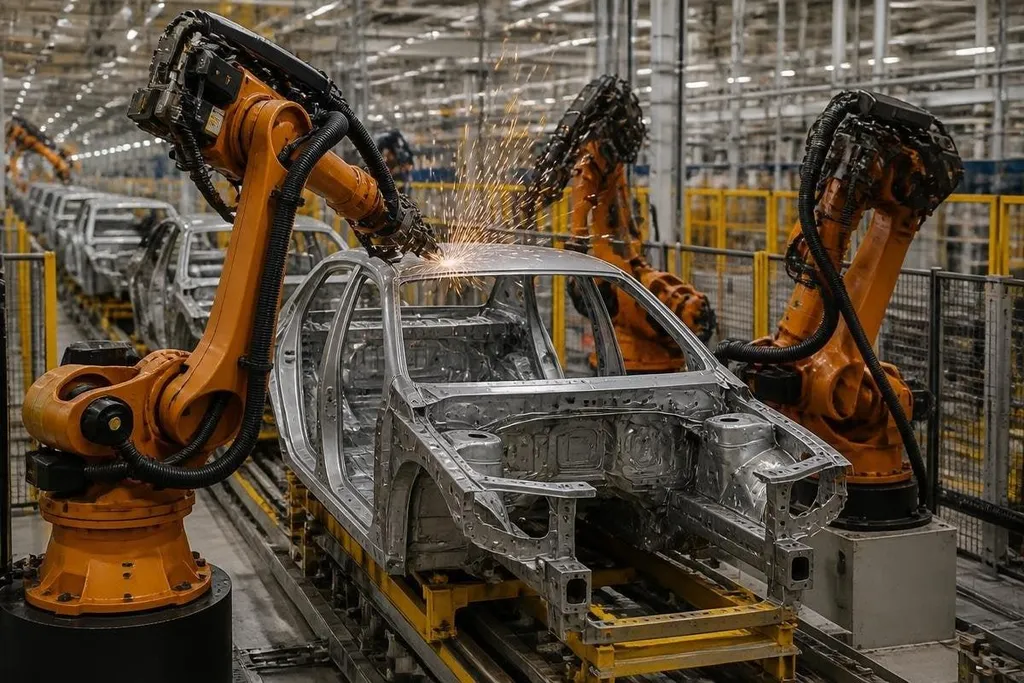
A modern vehicle may pass through welding, painting, inspection, and assembly stations before it reaches the road. Robots now handle many of these jobs because they can repeat the same motion for long production runs without losing position.
This matters to an automotive plant manager weighing new equipment, labor needs, and production changes. The value comes from steady work, safe handling, and the ability to collect useful process data.
- Robots repeat welding and handling paths with the same programmed motion.
- Machine vision checks parts while they move through production.
- The main limit is setup cost, not a lack of possible tasks.
Where robots do the work
Automotive robots are most useful where a task repeats often and the work area creates safety risks.
A six-axis robot arm can move around a vehicle body, change its wrist angle, and place a tool at set points. In spot welding, that repeatable path helps keep weld locations consistent across many bodies.
Painting brings a different need. The robot moves a spray tool at a set speed and distance from the panel, which helps control how much paint reaches each surface. A fixed motion also makes it easier to check the process when a panel shows an uneven finish.
Material handling is another common job. Robots can move body panels, glass, battery modules, or finished parts between stations. Their work depends on grippers, fixtures, sensors, and the layout of the conveyor, so the arm is only one part of the system.
Why the factory gains more than a robot arm
The largest change comes when the robot connects to the rest of the line. A controller can record cycle time, motor faults, tool changes, and stops. That record gives maintenance teams a way to find where a station loses time instead of waiting for a full line failure.
Machine vision adds another layer. A camera can check whether a part is present, whether a connector sits in the right place, or whether a weld point needs review. The check happens during production, which can reduce the number of faulty parts reaching a later station.
This does not make the line independent of people. Technicians still set the work cell, inspect tools, change programs, clear faults, and check safety systems. The work shifts toward setup, maintenance, and process control.
For a plant team weighing this shift, Robot24 can connect reports about automotive robots with the machines, companies, and production work behind them. That matters as battery plants add processes where repeatable handling and inspection may decide how much work the line can take on.
Battery plants raise the need for automation
Electric vehicles add new handling and inspection tasks. Battery modules are heavy, sensitive to damage, and built from parts that need careful placement. Robots can move modules with controlled speed while sensors check position before the next operation begins.
Battery production also needs traceability. A factory can link a part, inspection result, and production step to a record in its control system. That record helps a team find which station handled a problem part and what happened before it moved on.
The work still has limits. A robot designed for one body panel may need a new gripper, program, and safety check when the part changes. A plant that makes several vehicle models must plan for these changes before buying equipment.
I’d treat the robot as one part of a production cell, not as the whole automation plan. A well-set arm with poor fixtures or slow material supply will still leave the line waiting.
A practical buying check
Before adding a robot to an automotive process, check these points:
- Task repeat: Count how often the motion repeats during a shift and record the force, reach, and tool needed.
- Part changes: List the panels, modules, or tools that may change during the planned production run.
- Safety space: Map the robot cell, access doors, emergency stops, sensors, and worker paths before installation.
- Fault recovery: Set a clear method for finding a stopped station and returning it to work.
- Data link: Decide which cycle, fault, inspection, and maintenance records the control system must store.
- Human work: Assign who will program, service, inspect, and approve changes to the cell.
The next step is a small production trial with the real part, fixture, tool, and software link. If the cell holds its cycle time through that test and technicians can fix faults without long stops, the robot has a measured reason to stay in the line.